Nature Regeneration North Sea
Your host, Nature Regeneration North Sea, is driven by the Dutch government in close collaboration with industry partners, NGOs and knowledge institutes, and is funded predominantly through Dutch government and EU funding. The program aims at improving the North Sea ecosystem while supporting the sustainable development of offshore activities, including the energy transition. Our ambition is to bend the curve from ecological decline towards long-term ecosystem recovery. The program focuses on three interconnected ecosystem components: sea birds, fish and benthic habitats.
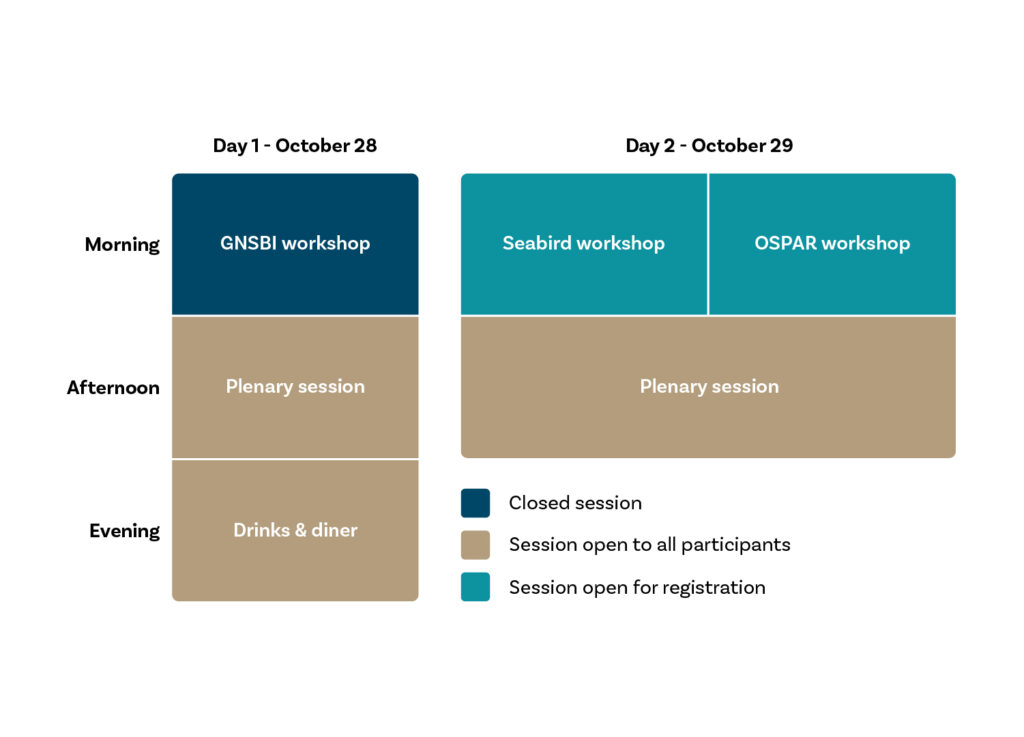
GNSBI-CBRTG
The GNSBI Cross – border Restoration Task Group (CBR TG) has been established within the Working Track Nature whose mandate includes promoting joint efforts to restore marine and coastal ecosystems, as set out in the 2024 Antwerp Ministerial Declaration. The Task Group brings together restoration experts nominated by GNSBI member countries, representatives from GNSBI observer organisations, and invited technical and scientific experts. It is led by Nature regeneration North Sea (Netherlands), Belgium, UK, with support from all other GNSBI countries. You can find out more about the task group and its objectives here.
OSPAR Task S6.O1.T2
The OSPAR Commission is the regional convention through which 16 governments and the European Union cooperate to protect and restore the marine environment of the North-East Atlantic. Through the North-East Atlantic Environment Strategy (NEAES) 2030, OSPAR aims to halt biodiversity loss, reduce pollution, and strengthen ecosystem resilience. Strategic Objective 6 specifically focuses on restoring degraded marine habitats where feasible to safeguard ecosystem functioning and resilience to climate change.
Task S6.O1.T2, ‘Best practice sharing and implementation of active habitat restoration measures’ contributes to this objective by developing a shared knowledge base on effective restoration approaches. Supported by the Nature Regeneration North Sea program, the task brings together scientific evidence, restoration case studies, and practitioner experience to produce practical guidance for active restoration of habitats such as kelp forests, seagrass meadows, biogenic reefs, and saltmarshes and mudflats. The guidance focuses on key phases of restoration: site selection, design and implementation, monitoring, evaluation, and knowledge sharing.